10G CWDM vs DWDM: Choosing Optics for Fiber Networks
When a fiber network needs more 10G connections, installing additional fiber is not always practical. In metro, enterprise and service provider networks, available fiber resources may be limited or expensive to expand.
Wavelength-division multiplexing (WDM) allows multiple optical signals to share existing fiber infrastructure by using different wavelengths. Two common approaches are CWDM (Coarse Wavelength Division Multiplexing) and DWDM (Dense Wavelength Division Multiplexing).
Both support 10G connectivity, but they differ in channel density, equipment complexity and network scalability.
Start with the Available Fiber Infrastructure
A conventional duplex 10G optical link typically uses two fibers, one for transmission and one for reception. As connections increase, additional fiber pairs may be required.
CWDM and DWDM address this limitation by combining multiple wavelengths through optical multiplexers and demultiplexers.
A typical connection follows this structure:
10G WDM Transceivers → MUX/DEMUX → Fiber Link → MUX/DEMUX → 10G WDM Transceivers
Each optical channel operates at an assigned wavelength, allowing multiple 10G signals to share the same fiber infrastructure.
This approach is useful for campus interconnections, metropolitan networks and service providers expanding capacity over existing fiber routes.
CWDM: A Practical Choice for Moderate Channel Counts
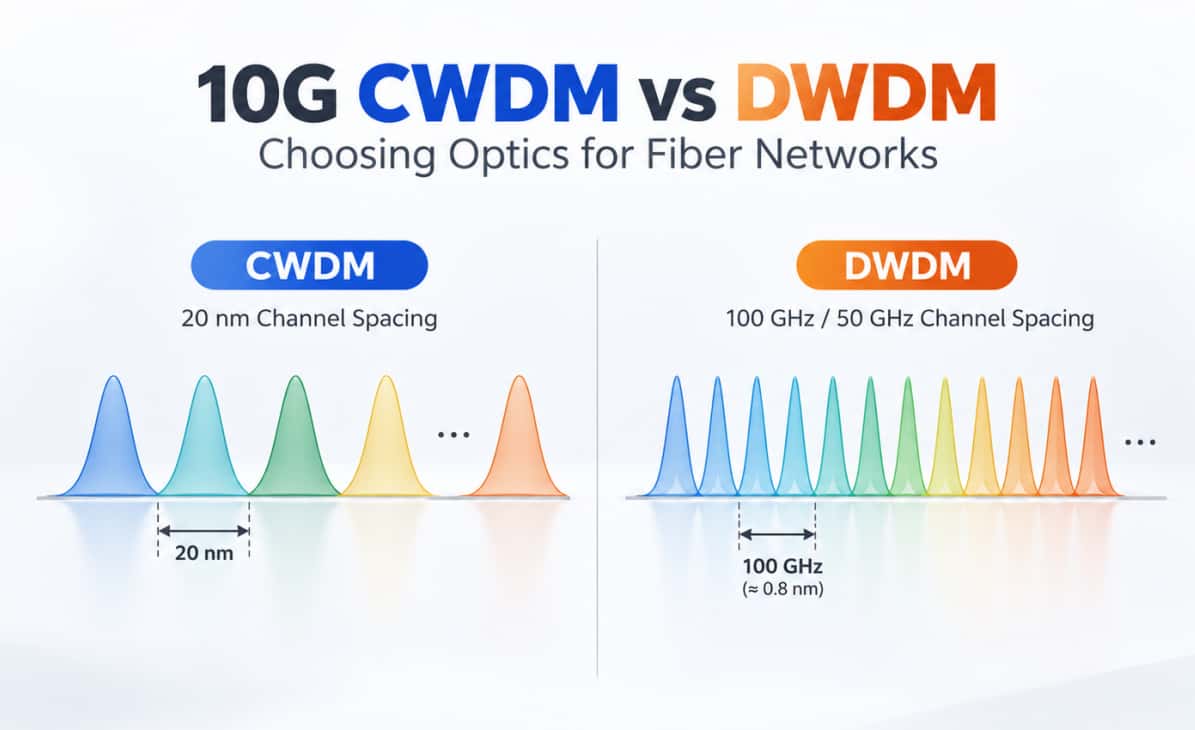
CWDM uses relatively wide wavelength spacing, typically 20 nm under the ITU-T G.694.2 standard.
The standard CWDM grid includes 18 nominal wavelengths from 1271 nm to 1611 nm. However, the number of usable channels depends on the optical modules, MUX/DEMUX equipment and fiber characteristics.
10G CWDM is commonly selected for networks requiring a moderate number of 10G channels without the complexity of a dense optical transport system.
Typical advantages include:
-
Passive MUX/DEMUX deployment in many applications
-
Wider wavelength spacing
-
Relatively simple network planning
-
Lower equipment complexity in many configurations
CWDM transmission distance depends on the selected transceiver and total optical power budget rather than a single fixed reach limit.
DWDM: Higher Capacity on Limited Fiber
DWDM places optical channels closer together, allowing more wavelengths within a narrower optical spectrum.
Common DWDM systems follow the ITU-T G.694.1 frequency grid, with channel spacing such as 100 GHz or 50 GHz.
This higher channel density makes 10G DWDM suitable for networks requiring more 10G connections over limited fiber resources.
DWDM systems can also support optical amplification and more advanced wavelength routing, depending on the network architecture.
However, higher channel density requires careful attention to wavelength accuracy, optical filtering and equipment compatibility.
For smaller networks, CWDM may provide sufficient capacity with simpler deployment. DWDM becomes more attractive when channel requirements increase or future expansion demands greater wavelength density.
CWDM vs DWDM: Key Differences
|
Feature |
10G CWDM |
10G DWDM |
|---|---|---|
|
Channel spacing |
20 nm |
Commonly 100 GHz or 50 GHz |
|
Channel density |
Lower |
Higher |
|
Typical applications |
Campus, metro, enterprise |
Metro, carrier networks |
|
System complexity |
Generally lower |
Potentially higher |
|
Expansion capacity |
Moderate |
Greater |
|
Equipment cost |
Often lower |
Often higher |
|
Transmission distance |
Depends on optical budget |
Depends on optical budget |
These are general deployment characteristics. Neither technology has one universal transmission distance, and the actual reach depends on the optical modules, fiber route and system design.
Check Wavelength Compatibility Before Ordering
One common mistake is selecting a 10G WDM transceiver based only on transmission distance and data rate.
CWDM and DWDM modules must match the wavelength channels supported by the MUX/DEMUX equipment.
For example, a 1471 nm CWDM transceiver must connect through a compatible 1471 nm channel. DWDM modules must similarly match the required ITU frequency channel.
Before deployment, verify:
-
Transceiver wavelength or frequency channel
-
MUX/DEMUX channel compatibility
-
Optical power budget
-
Fiber attenuation and MUX insertion loss
-
Network equipment compatibility
The total optical loss should include the fiber route, connectors, splices and multiplexing equipment.
A transceiver with sufficient nominal reach may still fail if the complete link exceeds its supported optical power budget.
Which One Should You Choose?
For networks requiring a limited number of 10G channels, CWDM is often the simpler and more economical option. It provides additional capacity over existing fiber without unnecessary system complexity.
DWDM is better suited to networks requiring higher channel density, more flexible expansion or advanced optical transport capabilities.
The decision should start with three practical questions:
-
How many 10G channels are required now and in the future?
-
What is the total optical loss of the fiber route?
-
Does the existing multiplexing equipment support the selected wavelengths?
Neither CWDM nor DWDM is universally better. The right solution depends on fiber availability, channel requirements, optical budget and future network growth.
For reliable deployment, the transceivers, MUX/DEMUX equipment and fiber infrastructure should be selected as one complete optical system.
Related Article