How to Choose MPO Polarity for 40G, 100G and 400G Optical Links
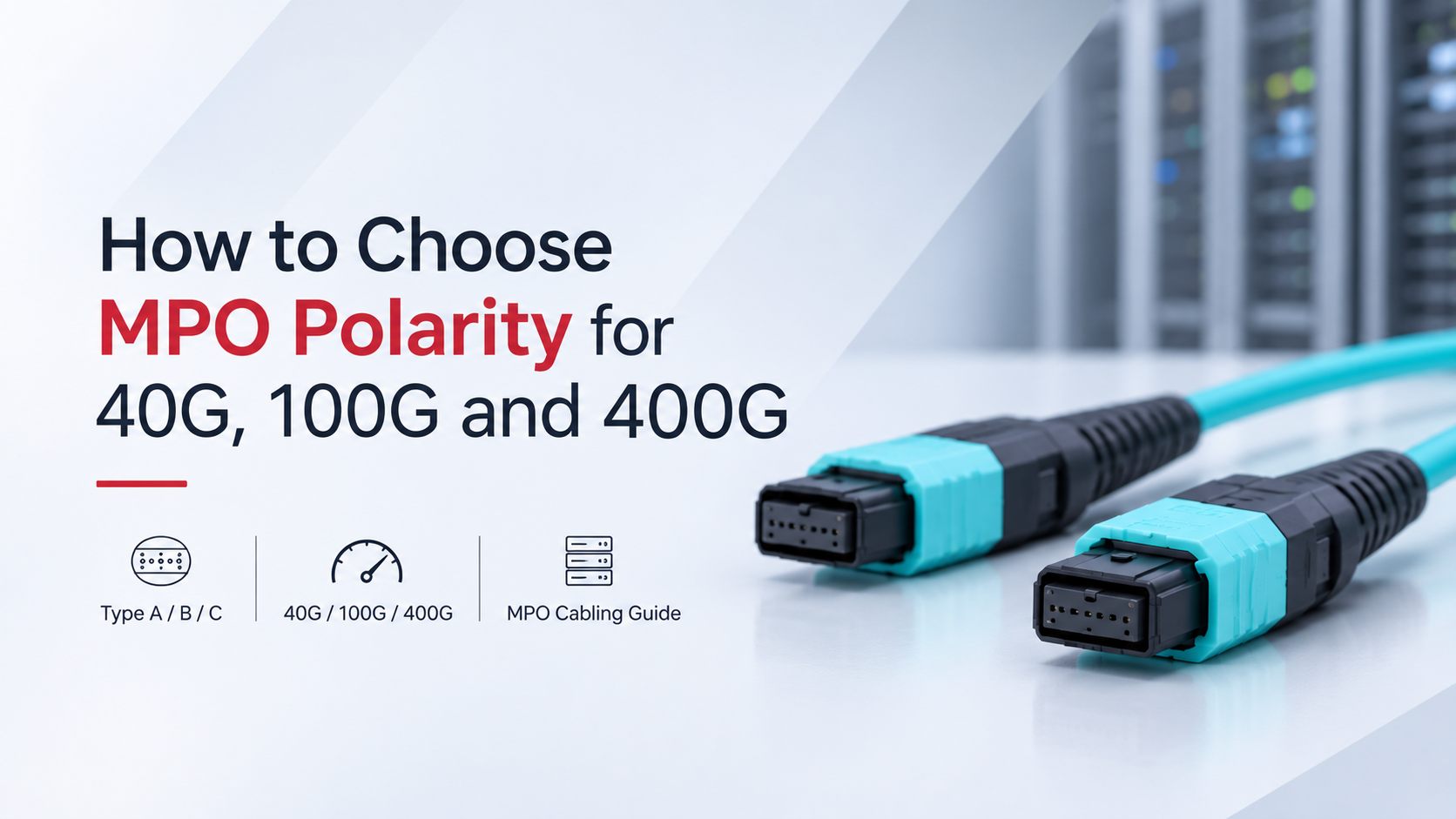
MPO connectors are widely used in high-speed data center networks because they can carry multiple optical fibers through a single connector. However, choosing an MPO cable is not only about fiber count, connector type, or transmission distance. MPO polarity is equally important because it determines how the fibers are connected between the two ends of an optical link.
For 40G, 100G and 400G applications, selecting the correct polarity helps ensure that the transmit and receive lanes are mapped correctly.
So, how should you choose the right MPO polarity for a high-speed optical link?
What Is MPO Polarity?
MPO polarity defines how the fiber positions at one end of an MPO cable correspond to the fiber positions at the other end.
For example, a straight-through configuration may connect:
1 → 1, 2 → 2, 3 → 3
while a reversed configuration may connect:
1 → 12, 2 → 11, 3 → 10
This fiber mapping is important for parallel optical transmission, where different fibers are assigned to different Tx and Rx lanes.
When selecting an MPO cable polarity, you therefore need to consider not only the connector itself but also the optical modules and the complete cabling architecture.
Type A, Type B and Type C MPO Polarity
The three commonly discussed MPO polarity configurations are Type A, Type B and Type C.
| Type | Fiber Mapping | Main Characteristic |
|---|---|---|
| Type A | Straight-through | Same fiber position at both ends |
| Type B | Fully reversed | Fiber positions are reversed |
| Type C | Pairwise reversed | Adjacent fiber pairs are swapped |
Type A
Type A uses straight-through fiber mapping, such as 1→1 and 2→2.
It is often used in structured cabling systems where the required fiber crossover is provided by other components in the link.
Type B
Type B reverses the complete fiber sequence, such as 1→12 and 2→11 for a 12-fiber MPO cable.
It is commonly used for direct parallel-optics connections because the fiber reversal can provide the required Tx-to-Rx lane mapping.
Type C
Type C reverses fibers in adjacent pairs, such as 1↔2 and 3↔4.
It is mainly associated with specific duplex-oriented cabling designs and should not be selected automatically for parallel 40G, 100G or 400G links.
Which MPO Polarity Is Used for 40G and 100G?
For common parallel optical applications such as 40GBASE-SR4 and 100GBASE-SR4, Type B is frequently used in direct MPO-to-MPO connections.
The reason is simple: these applications use multiple parallel optical lanes, so the fibers need to be mapped correctly between the transmitting and receiving transceivers.
A typical direct connection can be represented as:
40G/100G Transceiver → MPO Cable → 40G/100G Transceiver
In this type of connection, the cable polarity directly affects the fiber mapping between the two transceivers.
However, the answer can be different in a structured cabling system. If MPO trunks, cassettes, adapters or breakout assemblies are used, the polarity of the entire channel needs to be considered rather than selecting the trunk cable independently.
How About 400G MPO Polarity?
400G applications require more careful checking because different 400G optical standards can use different fiber counts and connector configurations.
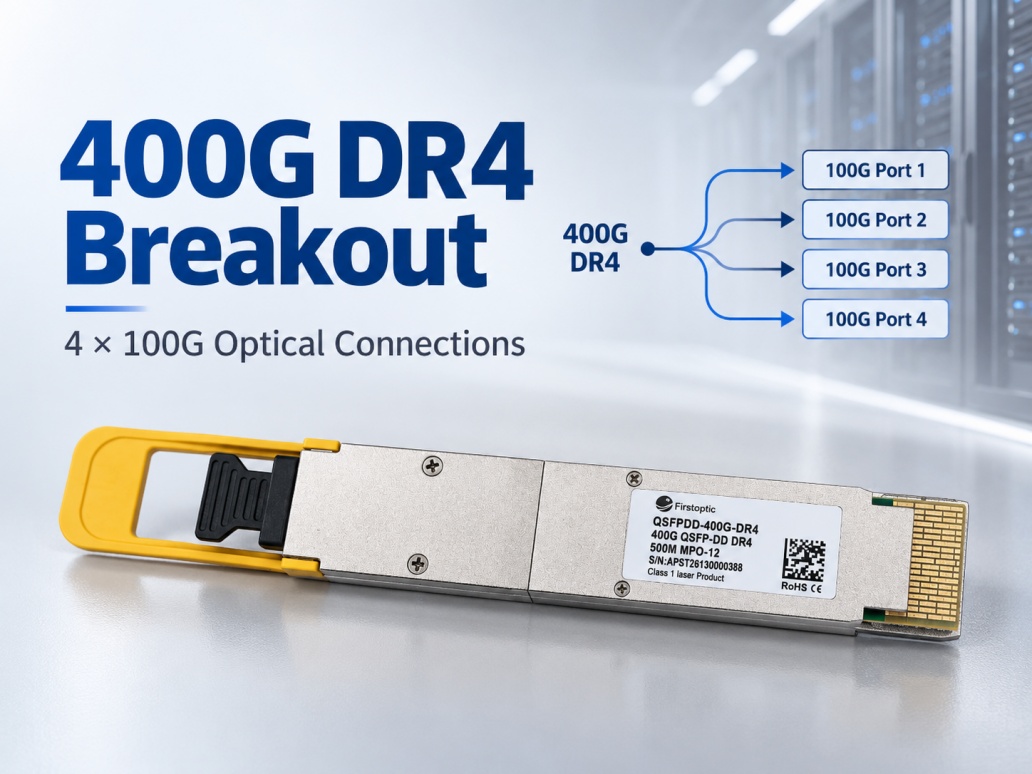
For example, 400GBASE-DR4 and 400GBASE-SR8 do not use exactly the same optical architecture.
Therefore, it is not accurate to say that every 400G link simply requires one specific MPO polarity.
Before selecting an MPO polarity for 40G 100G 400G, check:
- The exact optical standard
- MPO connector type and fiber count
- Fiber type
- Connector gender
- Key orientation
- Required fiber mapping
- Whether the connection is direct or structured
For a direct parallel-optics connection, Type B may be appropriate, but the transceiver specification and complete link design should always be verified first.
MPO Polarity Selection by Application
The following table provides a practical starting point:
| Application | Typical MPO Application | Polarity Consideration |
|---|---|---|
| 40GBASE-SR4 | Parallel multimode optics | Type B commonly used for direct links |
| 100GBASE-SR4 | Parallel multimode optics | Type B commonly used for direct links |
| 100G PSM4 | Parallel single-mode optics | Verify the required fiber mapping |
| 400GBASE-DR4 | Parallel single-mode optics | Verify transceiver and channel design |
| 400GBASE-SR8 | Higher-fiber-count parallel optics | Verify MPO configuration and mapping |
This table should be used as a general selection reference. The manufacturer's transceiver and cabling specifications should take priority for a specific deployment.
Direct Connection or Structured Cabling?
This is one of the most important questions when selecting MPO polarity.
Direct MPO Connection
A direct connection may look like:
Transceiver A → MPO Cable → Transceiver B
In this case, the MPO cable itself plays an important role in creating the required fiber mapping. Type B is commonly used for direct parallel-optics connections.
Structured Cabling
A structured system may include:
Transceiver → MPO Patch Cord → MPO Trunk → Cassette → Patch Cord → Equipment
Here, polarity is determined by the complete optical channel.
Using the wrong polarity for only one component can result in incorrect fiber mapping and prevent the optical link from operating correctly.
4 Things to Check Before Ordering an MPO Cable
Before purchasing an MPO cable for a 40G, 100G or 400G application, confirm these four points:
1. Optical standard
Identify the exact transceiver standard instead of selecting a cable based only on “40G”, “100G” or “400G”.
2. Connector configuration
Check whether the equipment requires MPO-12, MPO-16 or another connector configuration.
3. Polarity and gender
Confirm both the required fiber mapping and connector gender.
4. Complete link architecture
Determine whether the cable will be used in a direct connection or as part of a structured cabling system.
Getting these details right before installation can help avoid fiber-mapping problems and unnecessary cable replacement.
Common MPO Polarity Mistakes
1.Choosing polarity only by network speed
40G, 100G or 400G alone does not determine the correct MPO cable. The specific optical standard and network architecture must also be considered.
2.Confusing polarity with connector gender
Polarity defines fiber mapping, while gender determines whether the connectors can physically mate. They are two different specifications.
3.Using the same polarity for every MPO application
A polarity that works for a direct parallel-optics connection may not be appropriate for a structured cabling system.
4.Ignoring the complete optical path
When trunks, cassettes and patch cords are used together, polarity needs to be planned across the complete link.
Conclusion
Choosing the correct MPO polarity is an important part of deploying 40G, 100G and 400G optical links.
Type B is commonly used for direct parallel-optics connections because its full fiber reversal can provide the required Tx-to-Rx mapping. Type A and Type C are used in other cabling architectures depending on how the complete optical channel is designed.
The safest approach is to start with the exact optical standard and then verify the connector configuration, fiber mapping, polarity, gender and complete cabling architecture before ordering the MPO cable.
For high-speed data center networks, correct polarity planning can help reduce installation errors and ensure reliable optical connectivity.
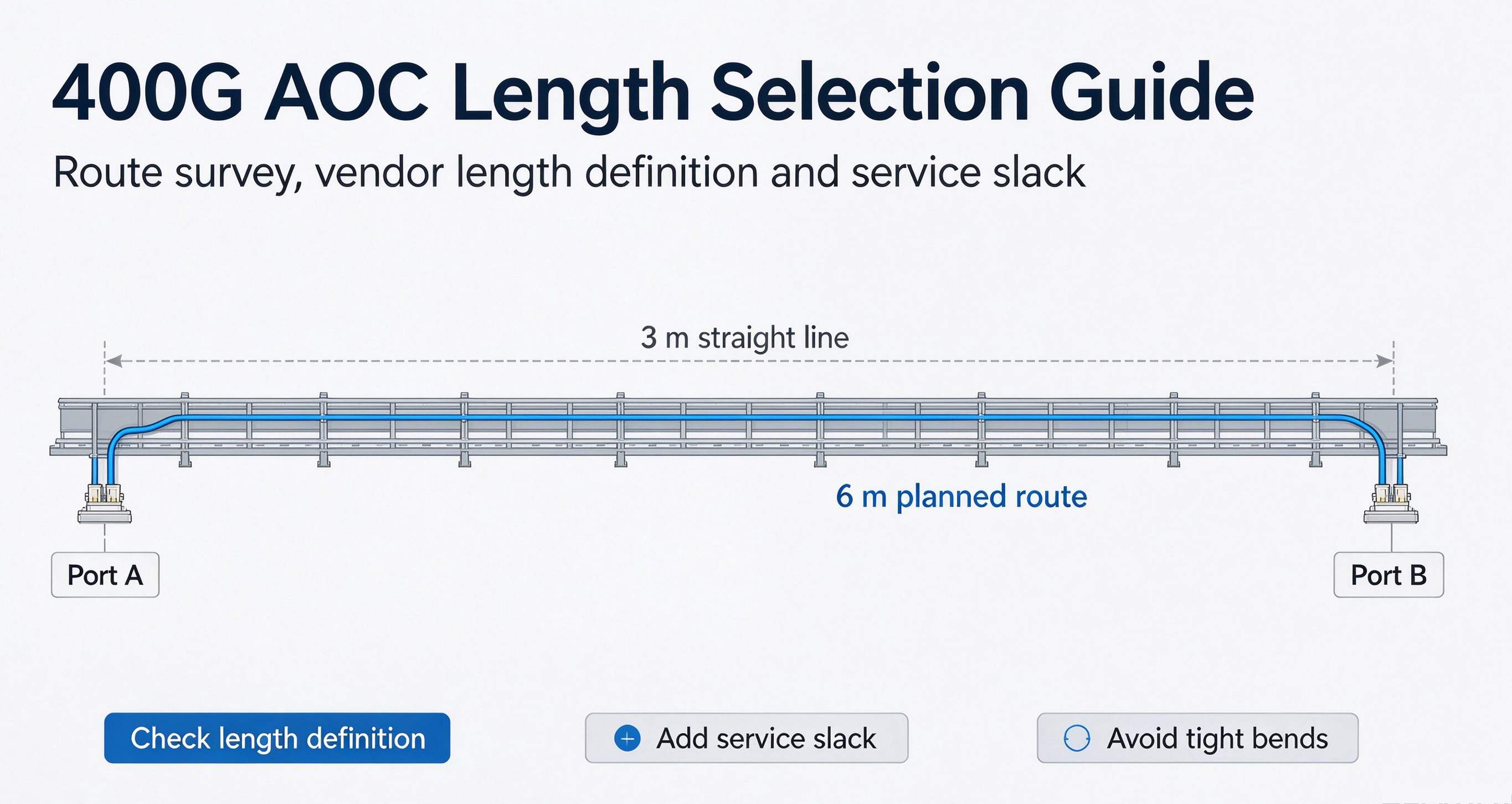
400G AOC Length: Measure the Route Before Ordering
Related Article