
Why More Data Centers Are Choosing Active Optical Cables Over DAC

As modern data centers continue evolving from 10G to 25G, 100G, 200G, and 400G Ethernet, selecting the right interconnect solution has become increasingly important.
Direct Attach Copper (DAC) uses integrated copper conductors for short-distance connections, while Active Optical Cable (AOC) integrates optical transceivers and optical fiber into a single factory-terminated assembly for longer, high-speed Ethernet links.
Although DAC remains an excellent choice for cost-sensitive, short-distance deployments, many operators are now adopting active optical cable solutions to support higher bandwidth, cleaner cabling, and more scalable network architectures.
Understanding the differences between DAC vs AOC helps network designers and IT managers choose the most appropriate solution for different deployment scenarios.
What Is the Difference Between DAC and AOC?
Although both products provide direct point-to-point Ethernet connectivity, they are designed for different deployment requirements.
DAC uses copper conductors and is ideal for very short-distance connections, while an AOC cable uses optical fiber to provide longer transmission distance, lighter weight, and better resistance to electromagnetic interference.
The following comparison highlights the main differences.
DAC vs AOC Comparison
| Feature | Passive DAC | Active DAC | AOC |
|---|---|---|---|
| Transmission Medium | Copper | Copper | Optical Fiber |
| Typical Distance | Up to 3m | Up to 7m | Typically 3–100m* |
| Power Consumption | None | Low | Low |
| Cable Weight | Heavy | Heavy | Light |
| Cable Diameter | Thick | Thick | Thin |
| EMI Immunity | Moderate | Moderate | Excellent |
| Initial Cost | Lowest | Medium | Higher |
| Best Application | Same Rack | Adjacent Rack | Rack-to-Rack & High-Density Networks |
Note: Actual transmission distance depends on Ethernet speed, cable type, and manufacturer specifications.
Why Are More Data Centers Moving from DAC to AOC?
1. Longer Transmission Distance
As server density increases, many network connections extend beyond the practical distance supported by DAC.
An active optical cable for data center typically supports longer transmission distances, making it suitable for rack-to-rack connections, server-to-switch deployments, spine-leaf architectures, and AI cluster networking.
2. Better Airflow in High-Density Racks
Compared with copper DAC, an AOC cable is lighter and significantly thinner, making cable routing much easier inside crowded network cabinets.
Improved airflow helps cooling systems operate more efficiently, which is increasingly important in AI data centers and high-density server environments.
3. Easier Cable Management
Modern data centers may contain thousands of network connections.
The smaller diameter of active optical cable solutions simplifies cable routing, reduces cable congestion, and makes future maintenance much easier.
4. Better Scalability for Future Upgrades
As organizations gradually migrate from 25G to 100G, 200G, 400G, and beyond, flexible cabling becomes increasingly valuable.
Compared with traditional copper solutions, AOC cable deployments provide greater flexibility for future bandwidth expansion while helping maintain clean and organized network infrastructure.
When Should You Choose DAC?
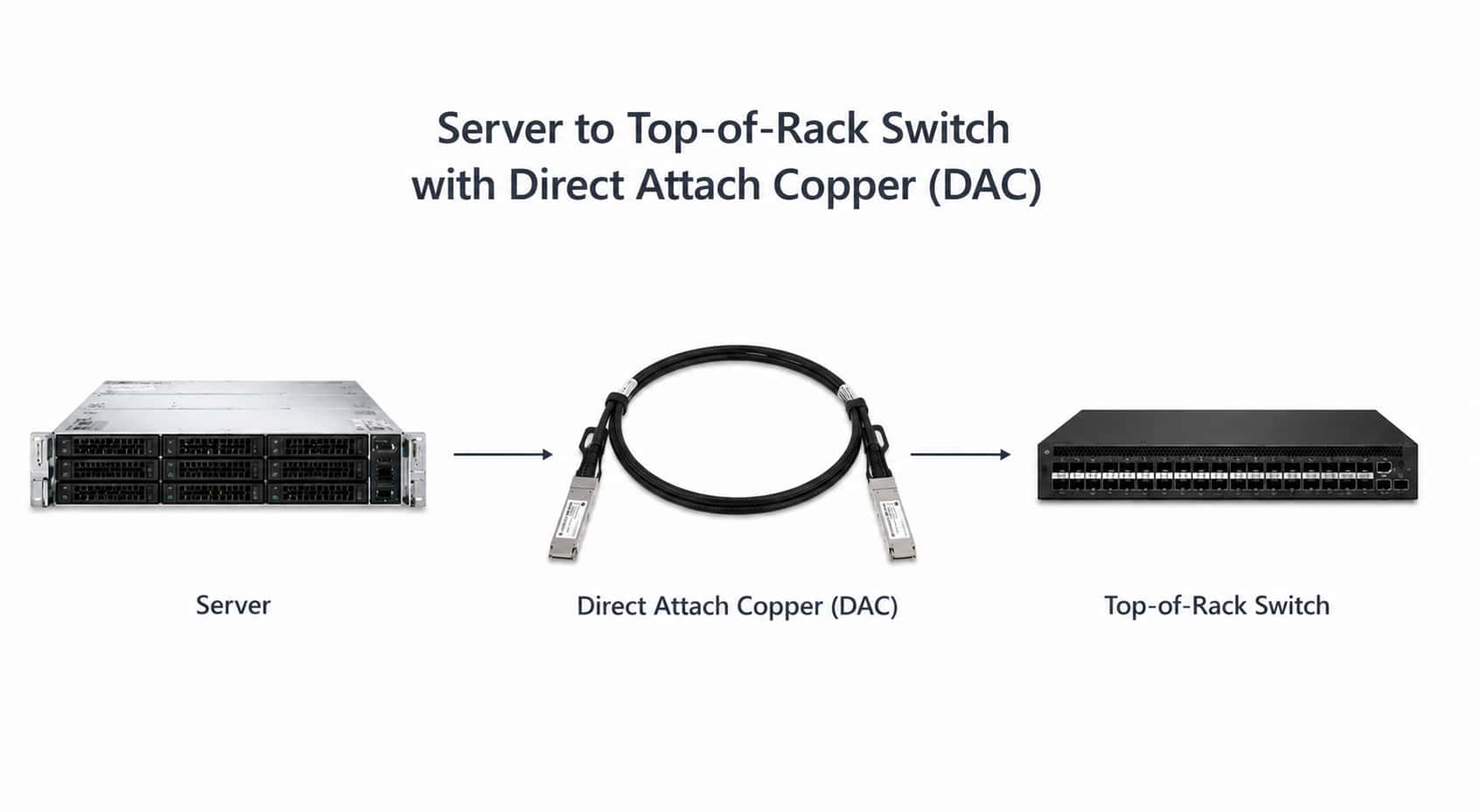
Although AOC offers many advantages, DAC remains the preferred solution in several situations.
Choose DAC when:
- Connection distance is within the same rack (typically up to 3m for passive DAC).
- Lower initial deployment cost is a priority.
- Ultra-low latency is required for specialized environments.
- Additional power consumption should be minimized.
For these applications, DAC remains a reliable and cost-effective choice.
When Should You Choose AOC?
An active optical cable is generally recommended when:
- Rack-to-rack connectivity is required.
- High-density cabinet deployment demands better airflow.
- Longer transmission distance is needed.
- AI clusters or cloud data centers require scalable optical interconnects.
- Simplified cable management is important.
For modern data center active optical cable deployments, AOC provides greater flexibility for future network growth.
Typical Deployment Scenarios
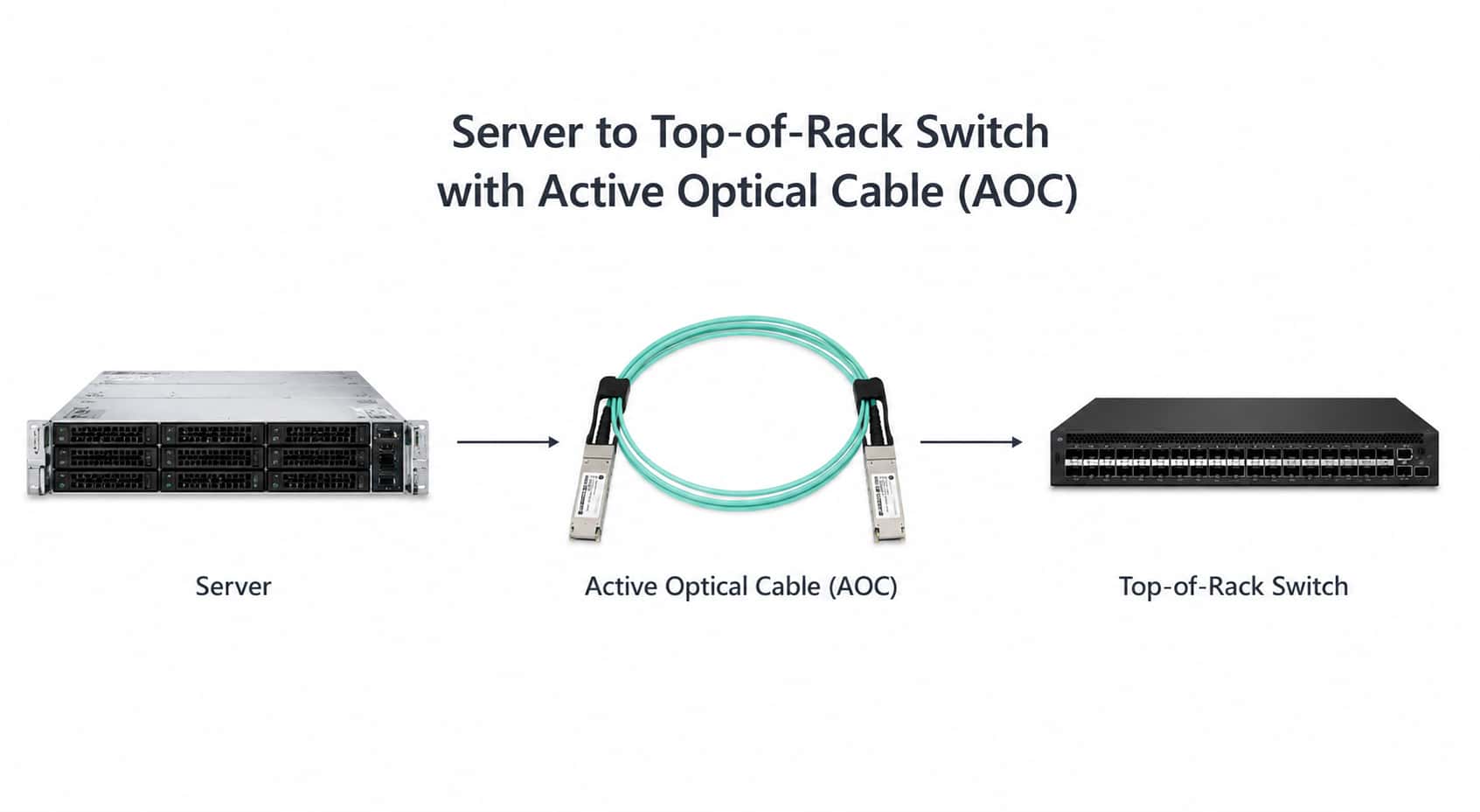
Enterprise Networks
25G AOC cable solutions are commonly deployed between servers and Top-of-Rack switches to simplify cable management.
Cloud Data Centers
100G active optical cable products are widely used for rack-to-rack and switch-to-switch connectivity where longer transmission distances are required.
AI Infrastructure
400G AOC solutions are increasingly deployed in GPU clusters and AI fabrics to reduce cable congestion while improving airflow inside high-density racks.
Common Mistakes When Choosing DAC or AOC
Selecting the wrong cable type can increase deployment cost and reduce network efficiency.
Common mistakes include:
- Using DAC for long rack-to-rack connections.
- Choosing AOC for very short same-rack links where DAC is sufficient.
- Ignoring switch compatibility before deployment.
- Selecting unnecessarily long cable lengths, resulting in poor cable management.
Evaluating transmission distance, network architecture, and future scalability before deployment helps avoid these issues.
Quick Selection Guide
| Your Requirement | Recommended Solution |
|---|---|
| Same Rack (≤3m) | Passive DAC |
| 3–7m Connections | Active DAC |
| Rack-to-Rack | AOC |
| High-Density Cabinets | AOC |
| AI & GPU Clusters | AOC |
| Lowest Initial Cost | DAC |
| Better Airflow | AOC |
Frequently Asked Questions
What is the main difference between DAC and AOC?
DAC uses copper conductors for short-distance transmission, while AOC integrates optical transceivers and fiber cable for longer-distance, high-speed Ethernet connectivity.
Is AOC more reliable than DAC?
Both solutions are reliable when deployed correctly. AOC offers better resistance to electromagnetic interference and is generally preferred for longer-distance and high-density deployments.
Which solution is better for rack-to-rack connections?
For rack-to-rack deployments beyond the practical distance of DAC, active optical cable is generally the preferred solution.
Does AOC consume more power than DAC?
Yes. Because AOC contains integrated optical transceivers, power consumption is slightly higher than passive DAC. However, the difference is generally negligible in modern data center applications.
Can AOC completely replace DAC?
No. DAC remains the preferred solution for short-distance, cost-sensitive connections, while AOC is better suited for longer distances, high-density deployments, and scalable network infrastructure.
Conclusion
Rather than replacing each other, DAC and AOC will continue to coexist in modern data centers.
DAC remains an excellent choice for short-distance, cost-sensitive deployments, while active optical cable solutions are increasingly adopted for high-density, high-bandwidth environments requiring longer transmission distances, improved airflow, and simplified cable management.
By understanding the strengths of DAC vs AOC , organizations can build more efficient, scalable, and future-ready network infrastructures.
How BiDi Optical Modules Reduce Fiber Costs in Enterprise Networks
AI Data Center Growth Brings New Challenges for Optical Interconnects
Related Article


