QSFP56 vs QSFP-DD: What’s the Difference?

As data center networks move from 100G to 200G and 400G, QSFP56 and QSFP-DD are widely used for high-speed optical and cable connections.
Although the two form factors have similar names, they differ mainly in electrical lane count, bandwidth capability, and typical applications.
Understanding these differences can help when selecting optical transceivers, DAC cables, AOC cables, and compatible switch ports.
What Is QSFP56?
QSFP56 is a four-lane pluggable form factor commonly used for 200G connectivity.
In a typical 200G Ethernet implementation, four high-speed electrical lanes use PAM4 signaling to provide an aggregate 200G-class interface.
QSFP56 is commonly available in:
- 200G optical transceivers
- 200G DAC cables
- 200G AOC cables
- Breakout cable configurations
Its compact QSFP-style form factor makes it suitable for high-density data center switching and server connectivity.
What Is QSFP-DD?
QSFP-DD stands for Quad Small Form-factor Pluggable Double Density.
Unlike QSFP56, which uses four electrical lanes, QSFP-DD provides eight electrical lanes. This double-density architecture enables higher aggregate bandwidth while maintaining a QSFP-style front-panel footprint.
QSFP-DD is widely used for 400G optical transceivers, DAC cables, and AOC cables. Newer generations of the QSFP-DD family also support higher network speeds.
QSFP56 vs QSFP-DD: Key Differences
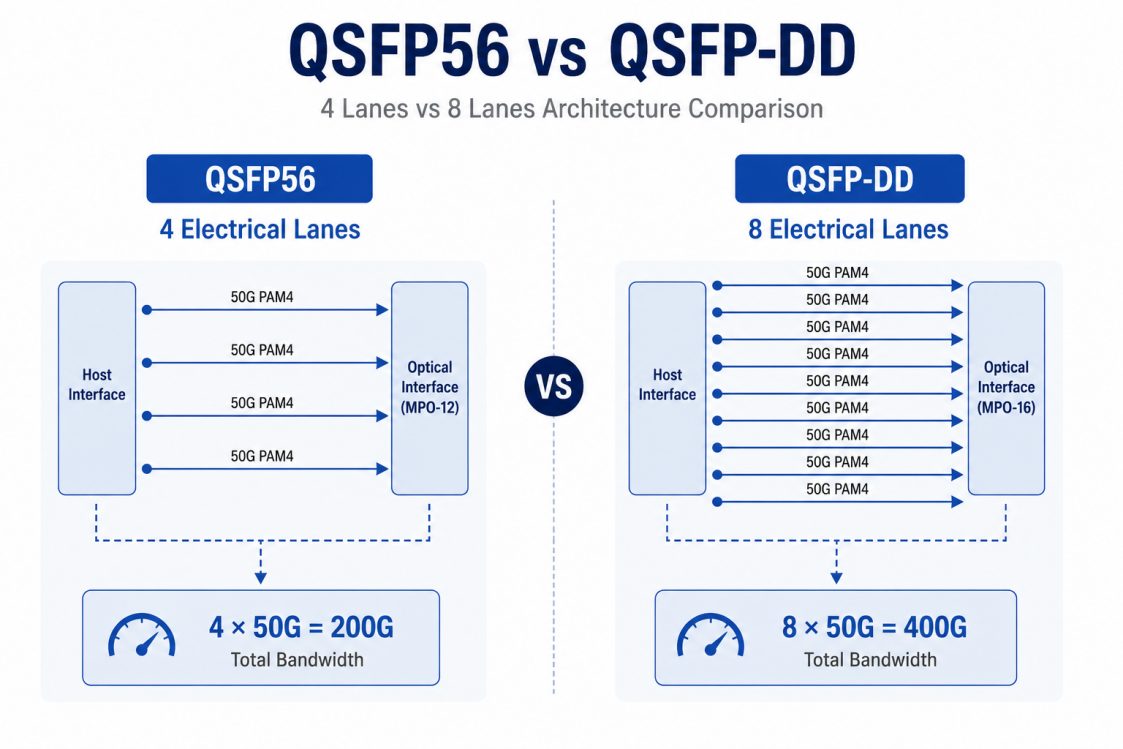
The key difference is therefore the electrical lane architecture, rather than simply the external appearance.
Are QSFP56 and QSFP-DD the Same Size?
The front-panel footprint is similar, but the modules are not physically identical.
QSFP-DD uses an additional row of electrical contacts to provide eight host lanes and is generally longer than four-lane QSFP modules.
This design allows network equipment to increase bandwidth while maintaining high front-panel port density.
Can QSFP56 Work in a QSFP-DD Port?
QSFP-DD was designed with backward compatibility with earlier QSFP-family modules in mind.
However, physical compatibility does not mean that every QSFP56 module will automatically operate in every QSFP-DD port.
Actual operation depends on the network platform, supported port speeds, firmware, port configuration, and transceiver compatibility.
For example, a QSFP-DD host port may need to support and be configured for 200G operation before using a QSFP56 device.
Always check the equipment manufacturer's compatibility information before deployment.
QSFP56 and QSFP-DD for DAC and AOC
QSFP56 DAC and AOC cables are commonly used for short-distance 200G connections between switches, servers, and other network equipment.
QSFP-DD DAC and AOC cables are commonly used for high-bandwidth 400G connections in data center environments.
Breakout configurations are also possible on supported platforms. For example, some 400G QSFP-DD connections can break out into multiple lower-speed interfaces, including 200G or 100G connections.
Breakout capability depends on the host port, lane mapping, cable design, and connected equipment.
How to Choose Between QSFP56 and QSFP-DD
Start with the host port and required network speed.
For a 200G QSFP56 port, a compatible QSFP56 transceiver, DAC, or AOC is generally the appropriate choice.
For a 400G QSFP-DD port, QSFP-DD connectivity is commonly used.
Before selecting a product, check:
- Required network speed
- Host port form factor
- Supported port mode
- Transmission distance
- Optical, DAC or AOC connection
- Breakout requirements
- Equipment compatibility
Conclusion
QSFP56 and QSFP-DD are both important high-speed network form factors, but they serve different bandwidth requirements.
QSFP56 uses four electrical lanes and is commonly used for 200G connectivity, while QSFP-DD uses eight electrical lanes and is widely deployed for 400G and higher-speed networks.
When selecting between them, network speed, host port capability, lane architecture, transmission medium, and equipment compatibility should all be considered.
MPO-8 vs MPO-12 vs MPO-16: What’s the Difference?
What Is an RJ45 SFP Module? A Guide to Copper SFP Transceivers
Related Article