What Is a Spine-Leaf Network Architecture and Why Do Modern Data Centers Use It?
As cloud computing, artificial intelligence (AI), and high-performance computing continue to grow, data centers require networks that can deliver higher bandwidth, lower latency, and greater scalability.
Traditional three-tier network architectures often struggle to handle the increasing volume of east-west traffic generated by virtualized workloads, distributed storage, and AI training clusters. As a result, Spine-Leaf network architecture has become the preferred design for modern cloud and AI data centers.
Traditional Three-Tier vs Spine-Leaf Architecture
Traditional data center networks typically consist of:
-
Access Layer
-
Aggregation Layer
-
Core Layer
While effective for north-south traffic, this design becomes less efficient as server-to-server communication increases.
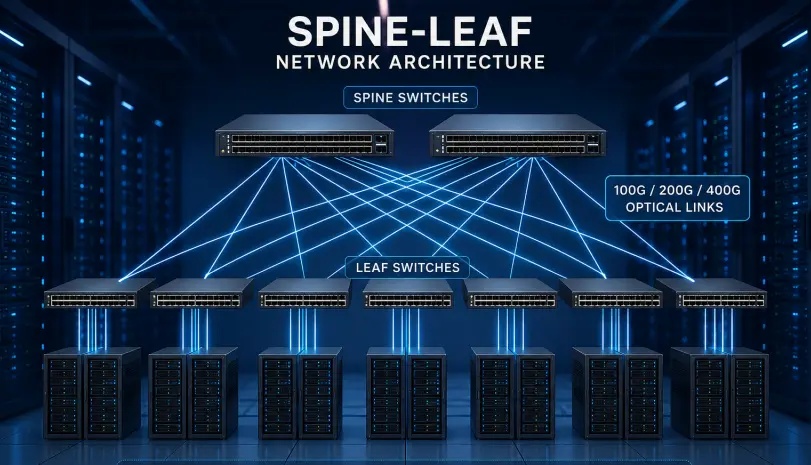
A Spine-Leaf architecture simplifies the network into two layers:
-
Spine Layer
-
Leaf Layer
Each Leaf switch connects to every Spine switch, creating a scalable Clos-based network fabric.
| Feature | Three-Tier Architecture | Spine-Leaf Architecture |
|---|---|---|
| Scalability | Limited | Excellent |
| East-West Traffic | Moderate | Optimized |
| Latency | Variable | Predictable |
| Redundancy | Moderate | High |
| AI Workloads | Less Suitable | Highly Suitable |
This design is particularly beneficial for cloud computing and AI environments where large volumes of east-west traffic are common.
How Does a Spine-Leaf Network Work?
Every Leaf switch connects to all Spine switches.
A typical traffic path is:
Server A → Leaf Switch → Spine Switch → Leaf Switch → Server B
Because all paths have the same number of hops, latency remains consistent across the network. Traffic can also be distributed across multiple paths, improving bandwidth utilization and redundancy.
Why Do Modern Data Centers Use Spine-Leaf?
1.Better Scalability
As server capacity grows, operators can add more Leaf switches. Additional Spine switches can also be deployed to increase overall network bandwidth without redesigning the entire infrastructure.
2.Optimized East-West Traffic
Modern applications generate significant server-to-server communication. This is especially important for AI training clusters, cloud platforms, and distributed storage systems.
3.Predictable Low Latency
Equal-cost paths help maintain consistent network performance across the data center, reducing bottlenecks and improving application responsiveness.
4.High Availability
Each Leaf switch connects to multiple Spine switches, allowing traffic to continue flowing even if a link or device fails.
5.Common Optical Connectivity in Spine-Leaf Networks
High-speed optical interconnects are essential for Spine-Leaf deployments.
Common solutions include:
1.100G QSFP28 Optical Transceivers
Widely used in enterprise and cloud data centers for cost-effective high-speed connectivity.
2.200G QSFP56 Optical Transceivers
Provide increased bandwidth while maintaining efficient power consumption.
3.400G QSFP-DD Optical Transceivers
Commonly deployed in hyperscale and AI data centers where higher port density and network capacity are required.
DAC and AOC Solutions
-
DAC cables are ideal for short-distance rack-level connections.
-
AOC cables provide longer reach, lighter weight, and improved airflow.
MPO Fiber Cabling
MPO cabling supports high-density deployments and simplifies migration to 100G, 200G, 400G, and future 800G networks.
Spine-Leaf Architecture for AI Data Centers
Large AI training environments require thousands of GPUs to exchange data continuously.
To support this traffic efficiently, many AI operators deploy Spine-Leaf fabrics combined with 400G and 800G optical interconnects. This approach provides the bandwidth, scalability, and reliability needed for modern AI workloads.
Conclusion
Spine-Leaf network architecture has become the foundation of modern cloud and AI data center networking.
Compared with traditional three-tier designs, it offers better scalability, predictable latency, improved redundancy, and stronger support for east-west traffic.
Combined with high-speed optical transceivers, AOC cables, DAC solutions, and MPO fiber infrastructure, Spine-Leaf networks provide the performance and flexibility required for next-generation 100G, 200G, 400G, and future 800G deployments.
How BiDi Optical Modules Reduce Fiber Costs in Enterprise Networks
How Does 40G QSFP+ to 10G SFP+ Breakout Cabling Work?
Related Article