AOC vs Fiber Patch Cord + Optical Transceiver: Which One Should You Choose for Your Data Center?
| Comparison Item | AOC | Fiber Patch Cord + Transceiver |
| Deployment Convenience | Plug-and-play, fast deployment | Separate installation required |
| Flexibility | Fixed interfaces, poor flexibility | Freely match interfaces and fiber types |
| Transmission Distance | Short-range (≤100m) | Short to long-range (up to 10km+) |
| Initial Cost | Lower (short-range) | Higher (short-range) |
| Long-term Maintenance Cost | Higher (replace entire cable) | Lower (replace only faulty part) |
| Fault Diagnosis | Difficult (cannot isolate components) | Easy (test transceiver and fiber separately) |
Core Definition (Simple Popular Science)
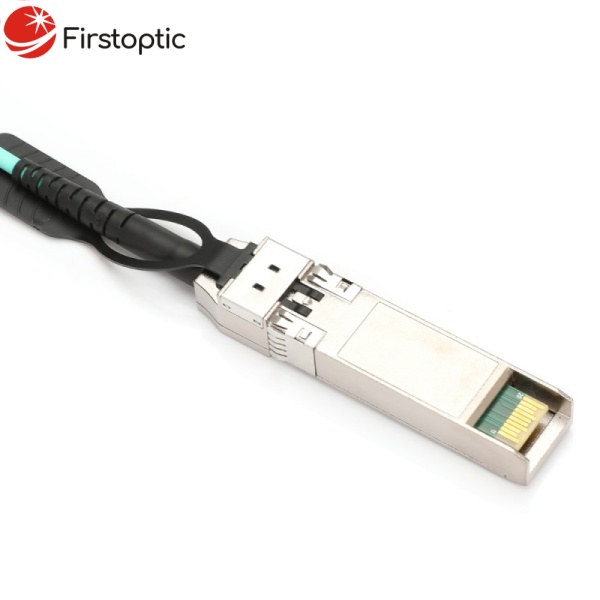
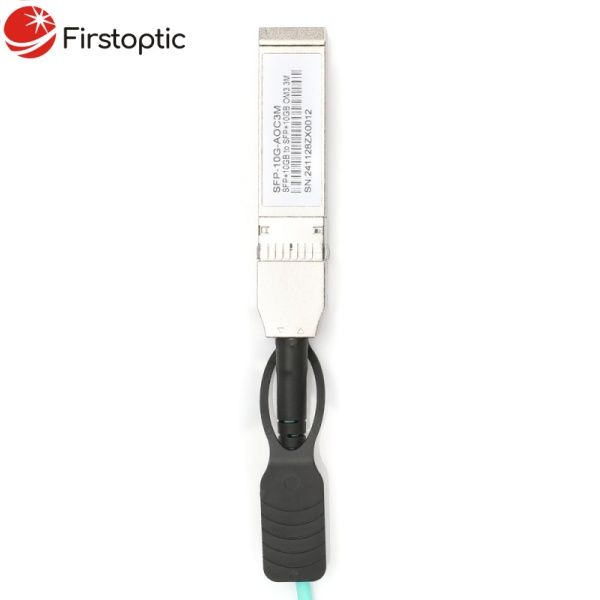
Active Optical Cable (AOC): Integrates optical transceivers at both ends of the cable. No need to match additional optical transceivers. Plug-and-play. Essentially, it is an integrated finished product of "optical transceiver + fiber patch cord".
Fiber Patch Cord + Optical Transceiver: Purchased and deployed separately. First, install the optical transceiver on the switch/server, then connect the transceivers at both ends with a fiber patch cord. This is a "split-type" solution.
Comprehensive Comparison of Pros and Cons
1. Deployment Convenience
Active Optical Cable (AOC)
-
Advantage: Integrated design, plug-and-play, no need to match transceiver models or debug, fast deployment speed, suitable for high-density cabinets and rapid expansion scenarios.
-
Disadvantage: Poor flexibility, fixed interfaces at both ends (such as QSFP-DD, SFP56), unable to replace interface types.
Fiber Patch Cord + Optical Transceiver
-
Advantage: Extremely flexible, can freely match optical transceivers (such as SFP, QSFP) and fiber patch cords (single-mode/multi-mode, different lengths) according to device interfaces and transmission needs, adapting to various device combinations.
-
Disadvantage: Cumbersome deployment, need to install transceivers and connect patch cords separately, and ensure compatibility between transceivers, devices and patch cords, which takes a long time.
2. Transmission Performance
Active Optical Cable (AOC)
-
Advantage: Stable transmission, integrated design reduces interface loss, low latency, supports short-range high-speed transmission (common 10G/25G/40G/100G, transmission distance 0.5-100m), meeting the needs of intra-cabinet and inter-cabinet interconnection in data centers.
-
Disadvantage: Limited transmission distance, cannot be used for long-distance transmission, and is slightly affected by ambient temperature, performance may degrade in high-temperature scenarios.
Fiber Patch Cord + Optical Transceiver
-
Advantage: Flexible transmission distance, can achieve short-range (50m) to long-range (10km+) transmission according to transceiver models (SR/DR/FR/LR), stable performance, less affected by the environment, and supports higher speeds (such as 400G/800G).
-
Disadvantage: More interfaces, prone to insertion loss. If the transceiver or patch cord is of poor quality, signal instability, packet loss and other problems may occur.
3. Cost Investment
Active Optical Cable (AOC)
-
Advantage: In short-range scenarios, the overall cost is lower (integrated integration is more cost-effective than purchasing transceivers + patch cords separately), and no additional debugging and maintenance costs are required.
-
Disadvantage: One-time investment, cannot be split and reused. If one end is damaged, the entire cable needs to be replaced, and the long-term operation and maintenance cost is slightly higher.
Fiber Patch Cord + Optical Transceiver
-
Advantage: Can be split and reused, transceivers and patch cords can be replaced separately. If a part is damaged, there is no need to replace the whole, and the long-term operation and maintenance cost is lower; in long-range scenarios, the cost advantage is more obvious.
-
Disadvantage: In short-range scenarios, the total cost of purchasing transceivers + patch cords separately is higher, and the initial purchase and debugging costs are higher.
4. Operation and Maintenance Difficulty
Active Optical Cable (AOC)
-
Advantage: Simple operation and maintenance, integrated design with no redundant interfaces, few fault points. If a problem occurs, the entire cable can be replaced directly without professional debugging.
-
Disadvantage: Difficult fault diagnosis, cannot separately detect problems with transceivers or fibers, can only replace and test as a whole.
Fiber Patch Cord + Optical Transceiver
-
Advantage: Convenient fault diagnosis, can separately detect optical transceivers (such as optical power, sensitivity) and fiber patch cords (such as loss), accurately locate fault points, and low replacement cost.
-
Disadvantage: High operation and maintenance complexity, need to regularly check transceivers, clean fiber end faces, and reserve different models of transceivers and patch cords, occupying inventory.
Selection Suggestions
Prioritize Active Optical Cable (AOC):
-
Intra-cabinet interconnection in data centers (≤50m)
-
High-density deployment
-
Rapid expansion scenarios
-
Scenarios pursuing convenience and low cost (such as AI server cabinets, small data centers)
Prioritize Fiber Patch Cord + Optical Transceiver:
-
Long-distance transmission (>50m)
-
Diverse device interfaces
-
Need for flexible reuse
-
Scenarios pursuing high performance and long-term operation and maintenance cost-effectiveness (such as cross-room interconnection, large data centers, operator networks)
Need Help Choosing the Right Solution for Your Project?
Selecting between AOC and traditional transceivers doesn't have to be complicated. We can help you evaluate your specific requirements – including distance, data rate, existing infrastructure, and budget – and recommend the most cost-effective solution.
How to Install Optical Transceivers Correctly (Avoid These 5 Common Mistakes)
Adaptation Issues Between Old Switches and New Optical Modules & Solutions
Related Article