
Why 25G Became the Building Block of 100G Data Center Networks

A 25G SFP28 optical module provides a single 25G channel in the compact SFP form factor. A 100G QSFP28 optical module uses four 25G electrical lanes to support an aggregate data rate of 100G. This shared lane architecture allows data centers to build efficient and scalable server access and aggregation networks.
Why Data Centers Moved Beyond 10G
A 10G SFP+ connection is still widely used in enterprise and data center networks. However, modern servers, storage systems and virtualized applications often require more bandwidth than a single 10G link can provide.
Combining several 10G connections increases the number of switch ports, modules and fiber links required. In comparison, a 25G SFP28 optical module delivers 2.5 times the bandwidth of a 10G SFP+ module while maintaining a similarly compact form factor.
This makes 25G suitable for server access networks that require higher port density and more efficient bandwidth utilization.
From 40G QSFP+ to 100G QSFP28
Earlier 40G QSFP+ interfaces were commonly based on four 10G lanes:
4 × 10G = 40G
QSFP28 retains the four-lane architecture but increases the speed of each lane from 10G to 25G:
4 × 25G = 100G
The transition from 40G to 100G was therefore achieved primarily by increasing the bandwidth of each lane rather than increasing the number of lanes. This development also created a direct technical relationship between 25G server connections and 100G network uplinks.For a broader overview of form factors and data rates, read our guide to SFP to QSFP28 optical transceiver evolution.
How Four 25G Lanes Create 100G
A 100G QSFP28 transceiver combines four 25G electrical lanes within one QSFP28 interface. Depending on the module variant, optical signals are transmitted either via parallel multimode fibers or multiple wavelengths over single-mode fiber.
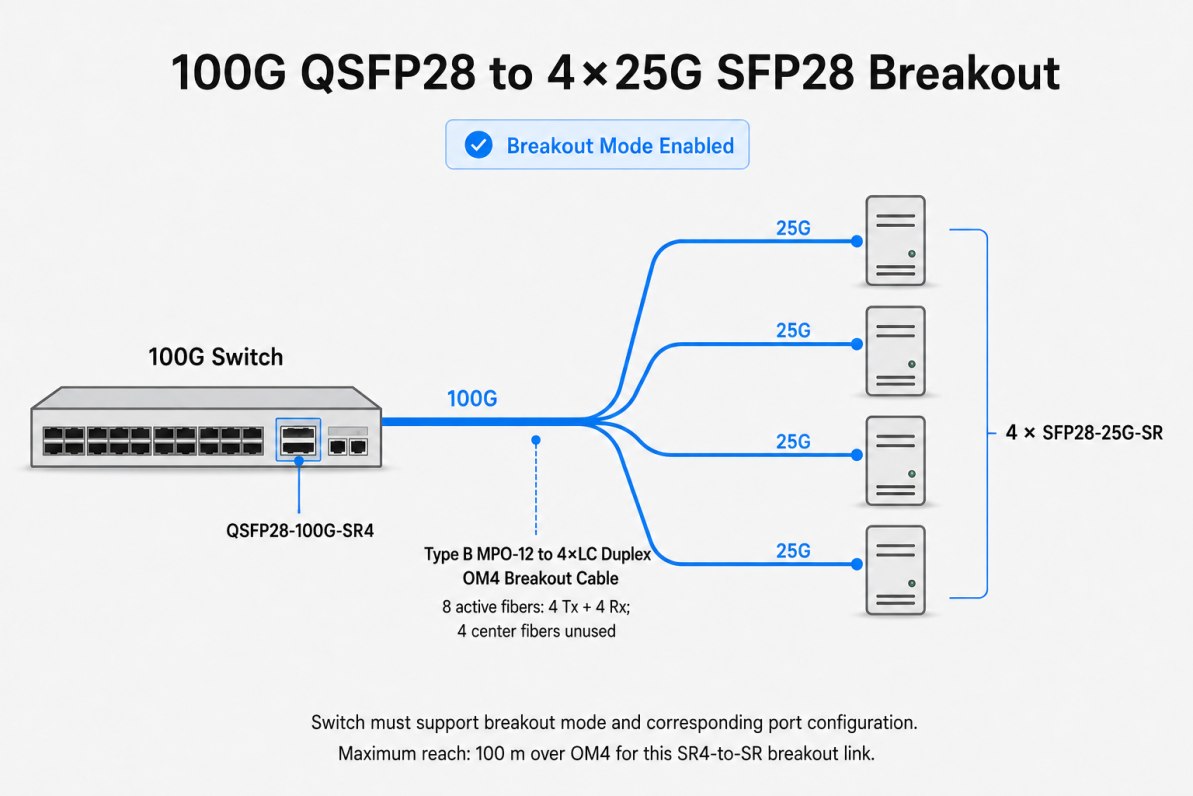
This lane structure can also support breakout applications. When the switch supports and is configured for breakout mode, one 100G QSFP28 port can operate as four independent 25G channels.
The connection requires a compatible QSFP28-to-4×SFP28 DAC, AOC or optical breakout solution. Not every 100G optical module can be directly divided into four standard 25G optical links, so the switch, module, cable and connector type must be checked together.
25G for ToR-to-Server Connections
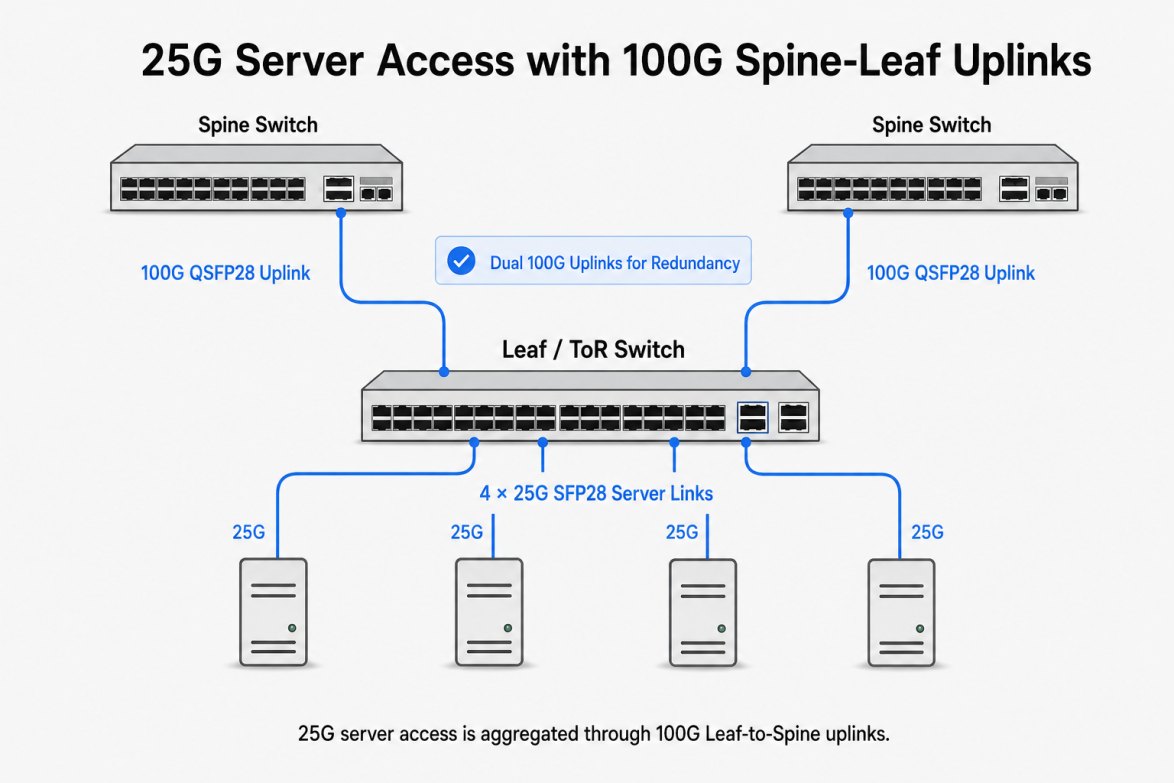
In a typical data center design, a Top-of-Rack switch connects directly to multiple servers. Each server can use a 25G SFP28 transceiver for a 25G connection to the ToR switch.
Compared with 10G, this provides more bandwidth for virtual machines, cloud applications, storage traffic and data-intensive workloads. It also allows network operators to increase server bandwidth without moving every server port directly to 40G or 100G.
For short-distance multimode links, 25G SFP28 SR modules are commonly used with LC duplex fiber. Longer connections can use LR or other single-mode options according to the required transmission distance.
100G for Spine-Leaf and Aggregation Links
While 25G is commonly deployed at the server access layer, 100G is often used for uplinks between Leaf and Spine switches.
A 100G QSFP28 optical module provides the aggregate bandwidth needed to carry traffic from multiple 25G server connections. This creates a balanced architecture in which several 25G access links are aggregated into 100G uplinks.
QSFP28 modules are available in SR4, CWDM4, LR4, ER4 and other variants. The correct option depends on the required distance, fiber type, connector interface and existing cabling infrastructure.
Planning a 25G to 100G Network Upgrade
A successful 25G to 100G network upgrade requires more than selecting higher-speed transceivers. Network operators should verify:
-
Switch, server and network adapter compatibility
-
Transmission distance and optical wavelength
-
Multimode or single-mode fiber requirements
-
LC duplex or MPO connector type
-
Forward error correction settings
-
Breakout capability and switch configuration
-
Compatibility of the DAC, AOC or optical breakout solution
Compatibility testing is especially important when transceivers are used with equipment from different network vendors.
Building a Scalable Data Center Network
The combination of 25G server access and 100G network uplinks provides a practical path for increasing data center capacity. The shared 25G lane architecture supports both direct 25G server connections and high-bandwidth 100G aggregation.
HCH provides 25G SFP28 and 100G QSFP28 transceivers, together with compatible DAC, AOC and fiber connectivity solutions. Available options include SR, LR, SR4, CWDM4 and other variants for scalable 25G and 100G data center networks.
From 100G to 400G: How PAM4 Changed Optical Networks
Understanding SFP, SFP+, SFP28, and QSFP Optical Modules: A Complete Guide
Related Article



