400G DR4 Explained: How It Works and Where It Is Used

400GBASE-DR4 is designed for short-reach transmission over parallel single-mode fiber. It supports links up to 500 meters and can also support 400G to 4×100G breakout connections.
Understanding its four-lane optical architecture makes it easier to see where DR4 fits into a 400G network.
How Does 400G DR4 Work?
400G DR4 uses four parallel optical lanes, with each lane carrying 100Gbps.
400G DR4
→ 4 × 100G optical lanes
→ 400Gbps total
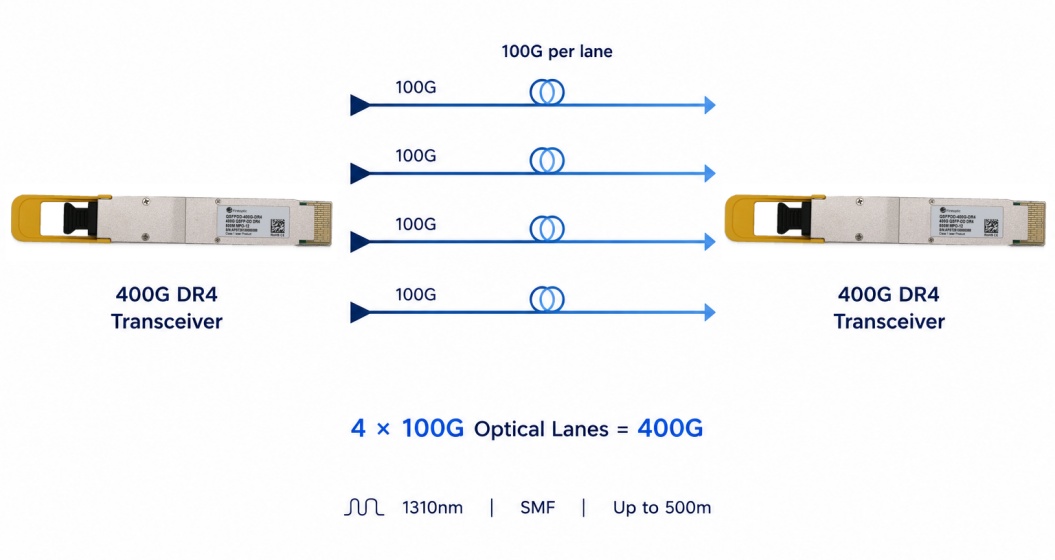
The optical lanes operate around 1310nm using PAM4 signaling. Four fibers are used for transmission and four for reception, giving a total of eight active fibers.
This is different from wavelength-multiplexed solutions such as 400G FR4. DR4 uses separate parallel fiber paths for its optical lanes, while FR4 carries four optical wavelengths over a duplex single-mode fiber pair.
[Figure 1 – How 400G DR4 Uses Four 100G Optical Lanes]
Why Does DR4 Use Parallel Single-Mode Fiber?
The four-lane architecture requires four transmit and four receive fiber paths:
4 Tx + 4 Rx = 8 active fibers
400G DR4 modules commonly use an MPO/MTP interface for these parallel single-mode connections. Depending on the module implementation, the physical connector may contain more positions than the eight fibers actively carrying traffic.
This is why the connector type and active fiber count should both be checked when selecting cabling for a DR4 link.The relationship between connector positions and active fibers is explained further in our MPO-8 vs MPO-12 vs MPO-16 guide.
How Far Can 400G DR4 Reach?
400GBASE-DR4 supports distances up to 500 meters over single-mode fiber.
That places it between short-reach multimode solutions and longer-reach single-mode options such as FR4.
| Optical Type | Fiber | Typical Reach | Architecture |
|---|---|---|---|
| 400G SR8 | Multimode | Up to 100m | 8 parallel lanes |
| 400G DR4 | Single-mode | Up to 500m | 4 parallel lanes |
| 400G FR4 | Single-mode | Up to 2km | 4 wavelengths over duplex fiber |
Distance is not the only consideration. Existing fiber infrastructure, connector type and breakout requirements can also influence which 400G optical solution is more suitable.
400G DR4 to 4×100G Breakout
One of the most useful characteristics of DR4 is its ability to support breakout connections.
Because the 400G optical interface consists of four independent 100G lanes, a compatible 400G DR4 port can connect to four separate 100G links.
400G DR4
↓
4 × 100G optical lanes
↓
4 × 100G connections
[Figure 2 – 400G DR4 to 4×100G Breakout Connection]
This can be useful during network upgrades. A 400G switch can provide high-density 400G ports while still connecting to equipment operating at 100G.
However, breakout support depends on the host platform as well as the optical modules. The switch port must support the required breakout mode, and the 100G optics on the other end must be compatible with the DR4 implementation.
Where Is 400G DR4 Used?
400G DR4 is mainly used for high-bandwidth, short-reach single-mode connections in data center environments.
Typical applications include:
- 400G switch-to-switch links
- Spine-to-leaf connections
- 400G to 4×100G breakout
- Cloud and AI data center networks
- Migration from 100G to 400G infrastructure
Its combination of 500-meter reach and breakout capability makes DR4 particularly useful where both native 400G connectivity and flexible 100G connections are required.
What Should You Check Before Deployment?
Before deploying 400G DR4, confirm:
- Host port and transceiver form factor
- Maximum link distance
- Single-mode fiber infrastructure
- MPO/MTP connector and polarity
- Platform compatibility
- Breakout support, if required
For breakout applications, also verify that the switch configuration and 100G optics are supported. Physical connectivity alone does not guarantee that the link will operate correctly.
Conclusion
400GBASE-DR4 uses four parallel 100G optical lanes to provide 400Gbps transmission over single-mode fiber up to 500 meters.
Its parallel architecture also supports 400G to 4×100G breakout, making it a practical option for high-density data center networks and gradual migration from 100G to 400G.
400G AOC vs DAC: Which Cable Is Right for Your Data Center?
MPO-8 vs MPO-12 vs MPO-16: What’s the Difference?
Related Article