Media Converter vs Ethernet Switch: What’s the Difference?

Media converters and Ethernet switches are both widely used in modern fiber networks, but they serve different purposes.
A media converter is mainly used for copper-to-fiber conversion and long-distance transmission, while an Ethernet switch is designed for communication between multiple devices within the same network.
Understanding the difference between these devices helps improve network deployment and infrastructure planning.
What Is a Media Converter?
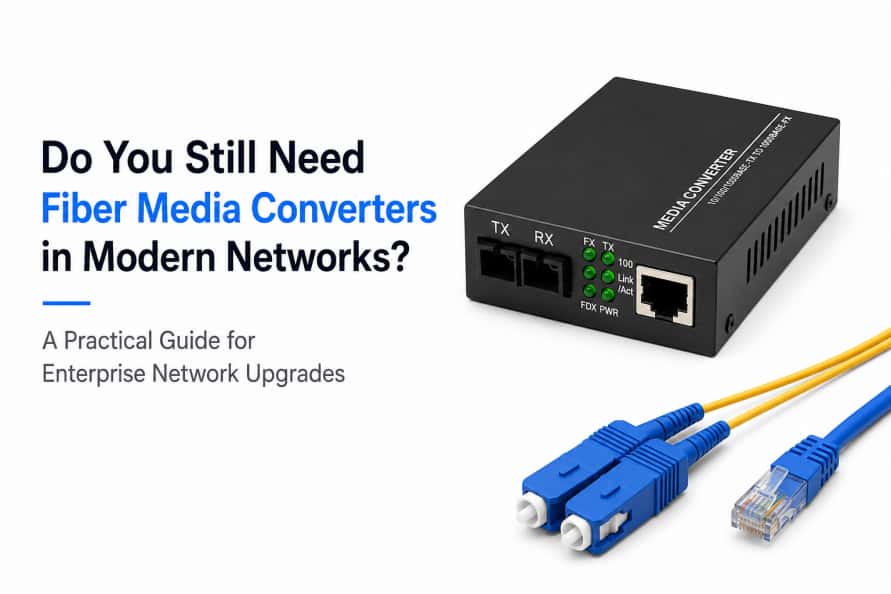
A media converter converts Ethernet electrical signals into optical signals for fiber transmission.
It is commonly used in:
- Long-distance fiber transmission
- CCTV surveillance systems
- Industrial communication
- Building-to-building fiber links
Most media converters provide:
- 1 × RJ45 Ethernet port
- 1 × SFP slot or fiber port
Media converters are typically deployed in point-to-point fiber extension environments where transmission distance is critical.
What Is an Ethernet Switch?
An Ethernet switch connects multiple devices within the same local network.
Unlike a media converter, a switch can manage communication between many connected devices simultaneously.
Ethernet switches are widely used in:
- Office networks
- Enterprise LAN environments
- Industrial networks
- Data centers
- IP surveillance systems
Modern Ethernet switches may support multiple RJ45 ports, SFP uplinks, VLAN management, and PoE functionality.
Media Converter vs Ethernet Switch
| Feature | Media Converter | Ethernet Switch |
|---|---|---|
| Main Function | Copper-to-fiber conversion | Multi-device communication |
| Number of Ports | Usually 1 RJ45 + 1 fiber port | Multiple Ethernet ports |
| Transmission Distance | Long-distance extension | Local network distribution |
| Network Management | Usually unmanaged | Managed or unmanaged |
| Typical Deployment | Point-to-point fiber links | Multi-device networking |
Media converters focus on transmission distance, while Ethernet switches focus on network connectivity and traffic management.
Typical Deployment Scenarios
In many real-world fiber deployments, media converters and Ethernet switches are often used together.
A common deployment structure is:
Switch → Media Converter → Fiber Cable → Media Converter → Remote Switch
This combination allows both long-distance fiber transmission and multi-device network expansion.
Conclusion
Media converters and Ethernet switches serve different but complementary roles in modern fiber networks.
Media converters are mainly used for media conversion and long-distance fiber extension, while Ethernet switches are designed for network communication and device connectivity.
Choosing the right solution depends on transmission distance, network structure, and deployment requirements.
How to Choose the Right Fiber Patch Cord for Your Network
What Is a Media Converter and How Does It Work?
Related Article