What Is a Media Converter and How Does It Work?

In modern fiber optic networks, one of the most important but often misunderstood devices is the media converter.
Many network engineers and buyers know they need fiber connectivity, but are not sure how to connect copper Ethernet systems with fiber infrastructure.
This is exactly where a media converter plays a critical role.
A media converter is a simple yet essential device that enables communication between copper-based Ethernet networks and fiber optic networks.
It allows data to travel over long distances without signal degradation, making it widely used in enterprise networks, industrial systems, and surveillance applications.
At HCH, media converters are commonly used in enterprise, industrial, and security monitoring network deployments where stable long-distance transmission is required.
What Is a Media Converter?
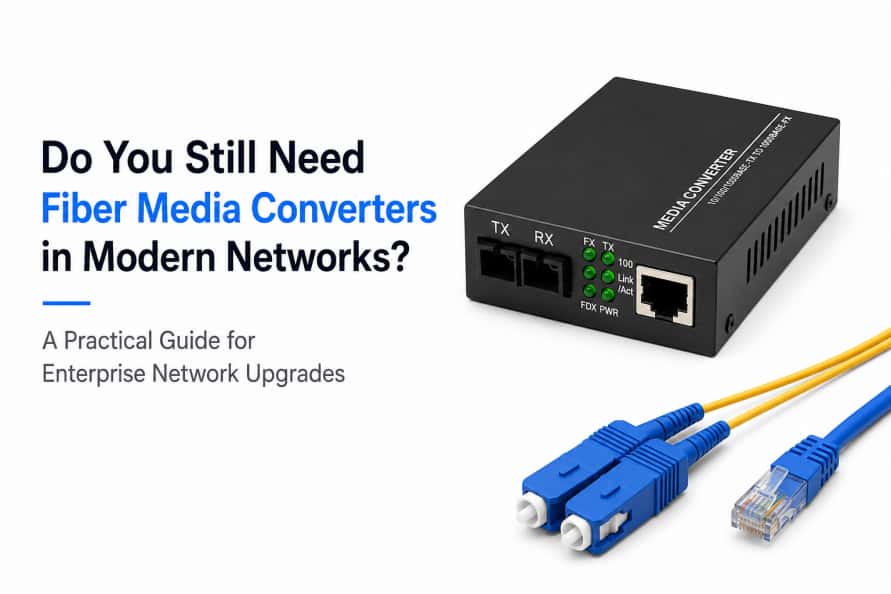
A media converter (also called a fiber media converter or optical media converter) is a networking device that converts electrical Ethernet signals into optical signals and vice versa.
In simple terms:
It connects copper Ethernet (RJ45) to fiber optic cable using fiber patch cord.
Without a media converter, copper-based Ethernet networks are generally limited to around 100 meters due to signal attenuation.
With fiber optic transmission and a media converter, network distance can extend to several kilometers or even tens of kilometers.
How Does a Media Converter Work?
A media converter performs two main functions:
1. Electrical-to-Optical Conversion
The device receives Ethernet electrical signals from RJ45 copper cables and converts them into optical signals for fiber transmission.
2. Optical-to-Electrical Conversion
At the receiving side, the optical signal is converted back into an electrical Ethernet signal for switches, computers, cameras, or other network devices.
This process is transparent to the network and usually requires no complex configuration.
Key Components Inside a Media Converter
A typical media converter includes:
- RJ45 Ethernet port
- Fiber optic port (SC, LC, or SFP slot)
- Optical transceiver module (for SFP-based models)
- Signal conversion chipset
- Power supply system
Some industrial models also include redundant power input and extended temperature protection.
Types of Media Converters
1. Standalone Media Converters
Simple plug-and-play devices commonly used in small office or basic network environments.
2. Managed Media Converters
Support monitoring and management functions such as link monitoring, VLAN, SNMP, or remote management.
3. Industrial Media Converters
Designed for harsh environments such as factories, transportation systems, and outdoor cabinets.
Industrial models typically support wider operating temperatures and enhanced protection.
Common Applications of Media Converters
HCH media converters are widely used in the following applications:
Fiber Network Extension
Extending Ethernet transmission beyond the 100-meter limitation of copper cables.
CCTV Surveillance Systems
Connecting IP cameras over long distances through fiber optic transmission.
Data Centers
Connecting Ethernet switches and network devices through fiber uplinks.
Industrial Automation
Providing stable communication in harsh industrial environments.
Campus and Building Networks
Connecting multiple buildings through long-distance fiber infrastructure.
Media Converter vs Ethernet Switch
Many users confuse media converters with Ethernet switches, but their functions are different.

A media converter does not manage network traffic. Its primary role is signal conversion between copper and fiber media.
Why Media Converters Are Still Important
Even with the growth of advanced switches and integrated fiber equipment, media converters are still widely used because they are:
- Cost-effective
- Easy to deploy
- Compatible with mixed copper and fiber environments
- Useful for extending existing network infrastructure
- Suitable for industrial and surveillance applications
For many small and medium-sized projects, media converters remain one of the most practical fiber deployment solutions.
Common Mistakes When Using Media Converters
Using the Wrong Fiber Type
Single-mode and multi-mode fiber must match the transceiver and transmission requirement.
Ignoring Transmission Distance
Different optical modules support different distances such as 550m, 10km, or 20km.
Using Unstable Power Supplies
Poor-quality power adapters may cause network instability or link failure.
Mixing Incompatible Optical Modules
Incorrect SFP coding or unsupported modules may prevent the link from establishing properly.

How to Choose the Right Media Converter
Before purchasing a media converter, consider the following factors:
- Fiber type (single-mode or multi-mode)
- Transmission distance
- Interface type (RJ45, SC, LC, or SFP)
- Deployment environment (commercial or industrial)
- Managed or unmanaged requirement
- Power supply requirement
Choosing the correct model helps ensure stable long-term network performance.
Recommended Related Products
You can also combine media converters with the following networking products:
- SFP optical transceivers
- Fiber patch cords
- Industrial Ethernet switches
- MPO fiber cabling solutions
These products are commonly deployed together in fiber optic communication systems.
Conclusion
A media converter is an important bridge between copper Ethernet and fiber optic networks.
It enables long-distance communication, simplifies network expansion, and helps reduce infrastructure costs.
Although modern switches now include more fiber interfaces, media converters remain widely used in enterprise, industrial, and surveillance applications because of their flexibility and cost-effectiveness.
HCH provides a wide range of media converters for enterprise, industrial, and fiber access networks, supporting different fiber types, transmission distances, and deployment environments.
If you are unsure which model fits your network, you can contact us with your switch model, fiber type, and transmission distance for selection support.
Media Converter vs Ethernet Switch: What’s the Difference?
Are Compatible Optical Transceivers Reliable? Testing and Quality Explained
Related Article