
Industrial vs Commercial Optical Transceivers: Why Temperature Rating Matters More Than You Think
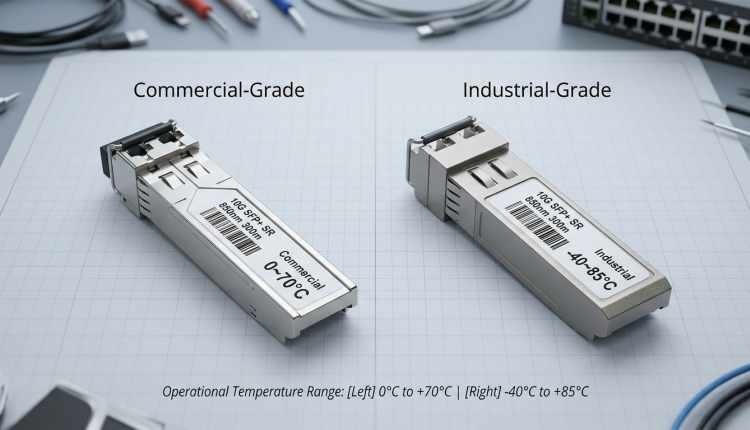
When a network goes down in extreme weather or a factory environment, the culprit is often not the switch or the fiber cable. It is the optical transceiver. More specifically, it is using a commercial-grade module in an industrial-grade environment.
This mistake happens frequently. The reason is simple: many buyers do not realize that the difference between commercial and industrial optical transceivers goes far beyond a number on a datasheet.
It is not just about temperature. It is about survival.
The Real Difference: Components and Testing
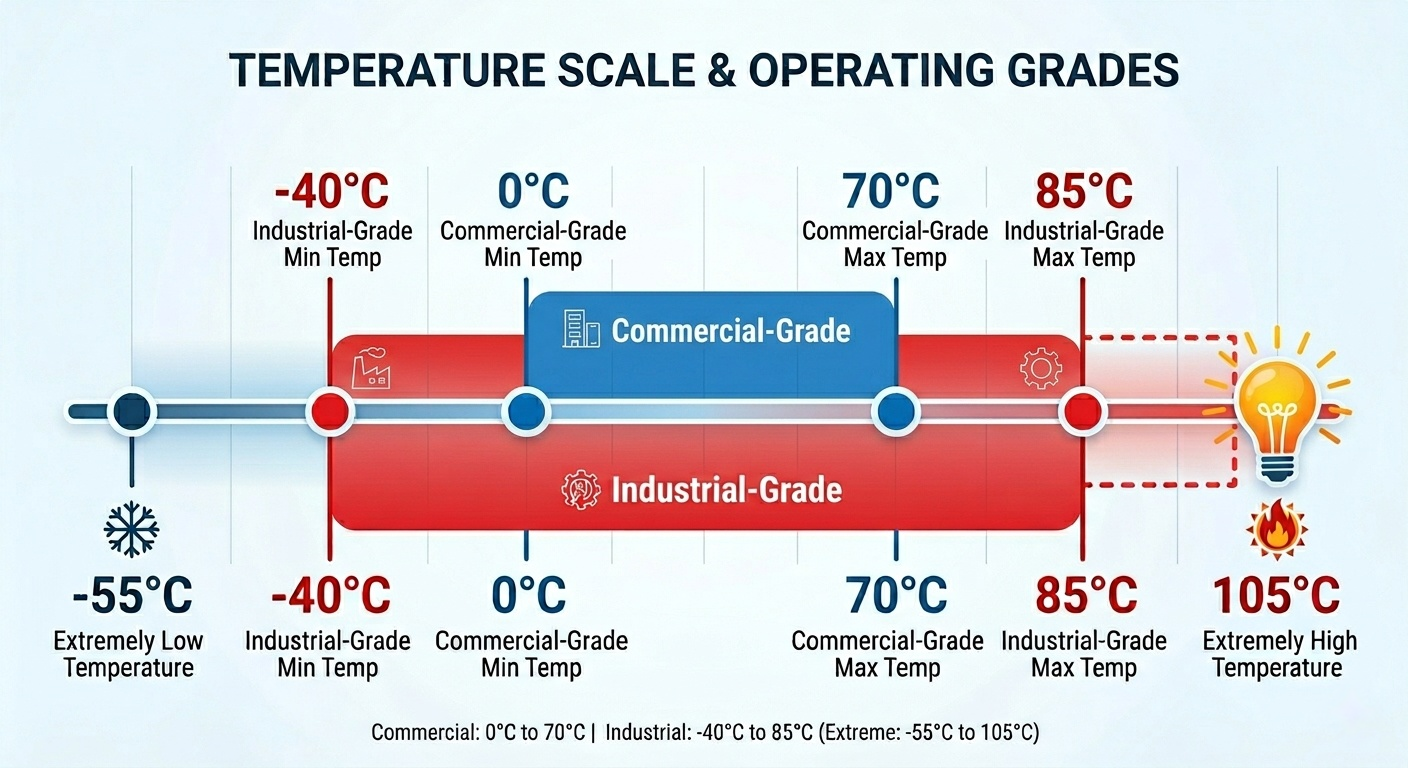
A commercial-grade optical transceiver (rated 0°C to 70°C) uses standard electronic components. These components work perfectly inside a temperature-controlled server room. But take them outside, and things change.
At -10°C, the oscillator frequency drifts. The laser driver becomes unstable. The photodiode loses sensitivity. The result? Intermittent signal loss, high bit error rates, and eventually, complete link failure.
An industrial-grade transceiver (rated -40°C to 85°C) solves this by using industrial-grade components:
-
Wide-temperature laser diodes
-
Automotive-grade passive components
-
Reinforced soldering and PCB design
But components alone are not enough. The manufacturing process is also different.
Industrial-grade modules go through stricter testing:
-
Temperature cycling (-40°C to 85°C, multiple cycles)
-
Burn-in testing (48 to 72 hours at high temperature)
-
Vibration and shock testing
-
EMC/EMI testing for industrial environments
Commercial-grade modules typically only receive functional testing at room temperature. This is why the MTBF (mean time between failures) difference is so large: ~100,000 hours for commercial vs 200,000+ hours for industrial.
When Commercial-Grade Works (And When It Does Not)
Commercial-grade is the right choice when:
-
The environment is indoor and climate-controlled
-
Temperature stays between 0°C and 70°C year-round
-
No strong vibration, dust, or electromagnetic interference
-
Examples: enterprise server rooms, data centers, office networks
Commercial-grade will fail when:
-
Installed in an outdoor cabinet (summer heat or winter cold)
-
Used in a factory with machinery generating heat and EMI
-
Placed near motors, welders, or high-power equipment
-
Mounted on a moving vehicle (train, ship, truck)
Industrial-grade is required for:
-
Outdoor base stations and small cell sites
-
Industrial automation and factory floors
-
Mining and tunneling operations
-
Rail transit and roadside infrastructure
-
Any environment where temperature falls outside 0-70°C, or where vibration/EMI is present
A Common Misconception
Some buyers think they can "test" a commercial-grade module in a harsh environment and if it works for a week, it will work long-term. This is dangerous thinking.
Industrial-grade design is not about surviving the first week. It is about surviving the third year after thousands of temperature cycles, vibration events, and power fluctuations. A commercial-grade module may work for a month in a hot outdoor cabinet. But as the capacitors age and solder joints crack from thermal expansion, failure becomes inevitable.
What This Means For Your Purchase
If you are deploying in a stable indoor environment, commercial-grade modules offer the best value. Paying for industrial-grade in this scenario is unnecessary.
If your deployment involves outdoor, industrial, or any non-climate-controlled space, industrial-grade is not an extra cost. It is a requirement. The price difference (typically 2-5x) is small compared to the cost of a network outage, truck roll, and replacement labor.
Summary
Commercial-grade works in your server room. Industrial-grade survives everywhere else. Choose based on where your equipment lives, not just what your budget says.
FTTR Full Fiber Networking: Driving Demand for Optical Modules and Fiber Jumpers
Optical Module Dust Caps: Hidden Value & Maintenance Standards
Related Article